Changing ATM and daily spend limits. Instantly
Reduced task effort from 5-7 mins to 30s, achieving 500% usage uplift
Role
Product Designer
Industry
Financial Services
Duration
2 months

Paper forms leading to 5-7m effort or switching products
Business customers need to adjust ATM and daily spend limits for urgent purchases, e.g. a builder replacing expensive equipment.
However the existing process forced them through a 4-page PDF form. This created friction that doesn't meet modern banking expectations. As a workaround, customer often used personal credit cards.
Initially stakeholders push for a lift and shift
This approach would have embedded legacy issues into a digital experience. After analysing the data, following are some of the issues;
Free text fields - the approach preserved legacy input fields, introducing cognitive burden and user error
Paradox of choice - the $9b daily spend limit vs. competitors' $20-50k created risk with little upside
Mental model mismatch - the 'available balance' option (daily spend + overdraft) forces the user to mentally calculate the best option
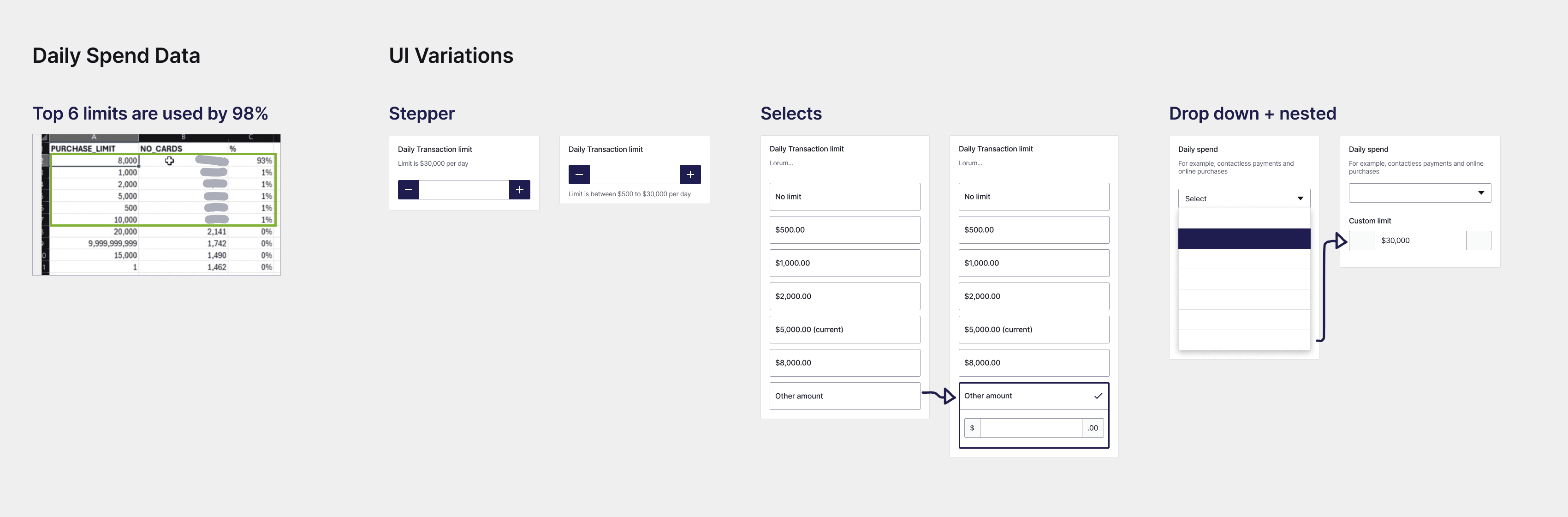
Usability testing with 6 users validated simplicity
The testing proved simplicity over exhaustive choice increased task speed and comprehension:
Progressive disclosure for limits - Provided 6 most popular options and nested custom limits in secondary flow to balance choice and cognitive load
Sensible 'defaults' - convinced Product Owner to set $30k maximum for digital form, which reduced decision fatigue and risk
Removed available balance - 4/6 user did not understand option

Result = 500% increase in usage
While the Product Owner celebrated the success, I analysed behavioral data for optimisation.
Post-launch analysis revealed concentrated usage patterns:
82% selected $2k daily limit
14% selected $30k daily limit
I recommended adding $30k as an additional limit. This project was a great reminder how framing, default options and lower/upper bounds shape decision making.